
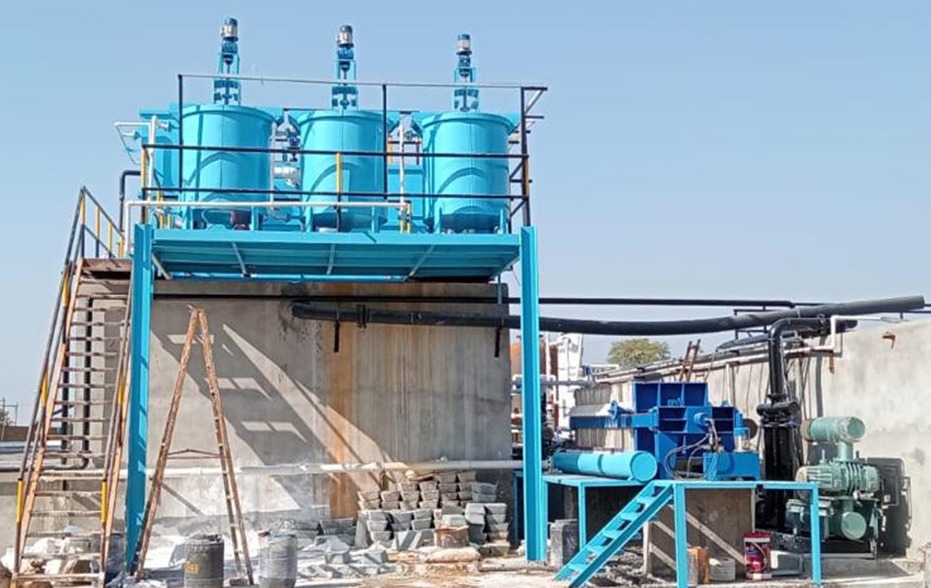
Mixed Bed Unit

Mixed Bed Unit

Overview:

  • Mixed-bed deionizers are normally used to ‘polish’ the water to higher levels of purity after it has been initially treated by either a two-bed deionizer or a reverse osmosis unit. In mixed-bed deionizers the Strong Acid Cation and Strong Base Anion resins are closely mixed and contained in a single pressure vessel. The thorough mixture of resins in a single column makes a mixed-bed deionizer equivalent to an extended series of two-bed plants. As a result, the water quality obtained from a mixed-bed deionizer is appreciably higher than that produced by a two-bed plant.
  • We at NK, provides broad range of custom-built Mixed Bed Units for high purity industrial process water & utility applications. Our exclusive design of Mixed Bed plant ensures the maximum utilization of the High bed depth, effective surface area, uniform space and linear velocity across the resin bed, which provides effective contact time between water and resin bed yield high purity water for sensitive process application i.e. WFI (water for Injection) High Pressure Boilers, EC circuits etc.
  • NK MB Plants are available in diameters from 0.225 mts. to 2.0 mts. with the flow rates up to 150 m3/hr. and OBR up to 1500 m3@40 PPM TDS. These strong, pre-engineered, pre-assembled units minimize installation and start-up costs. Our D.M. Plant is acclaimed in the market for cost efficiency and consistent functioning.


Working Principle:

  • A mixed bed exchange has both cation and anion resin mixed together in a single vessel. As water flows through the resin bed, the ion exchange process is repeated many times, “polishing” the water to a very high purity. During regeneration, the resin is separated into distinct cation and anion fractions. The resin is separated by back washing, with the lighter anion resin settling on top of the cation resin. Regenerate acid is introduced through the bottom distributor, and caustic is introduced through distributors above the resin bed. The regenerate streams meet at the boundary between the cation and anion resin and discharge through a collector located at the resin interface. Following regenerate introduction and displacement rinse, air and water are used to mix the resins. Then the resins are rinsed, and the unit is ready for service.
  • Counter flow and mixed bed systems produce a purer water than conventional cation-anion demineralizers, but require more sophisticated equipment and have a higher initial cost. The more complicated regeneration sequences require closer operator attention than standard systems. This is especially true for a mixed bed unit.

    Technical Specification:


Flow

0.5 m3/hr.– 150 m3/hr.

OBR

1500 m3

Inlet conductivity

Up to 70 micro Siemens / cm

Outlet conductivity

<1 micro Siemens / cm

Silica at outlet

Max 0.05 ppm as CaCO3

Total Hardness

NIL

Liner Velocity

4 to 80 m/hr.

Space Velocity

4 to 60 m/hr.

Type of Resin

Strong Acid Cation (H+ – Mono Type), Strong Base Anion (OH+ – Mono Type)

Type of Regenerate

HCL / H2So4 for SAC & NaOH for SBA.

Diameter (Vertical Vessel)

0.225 mts. – 2.0 mts.

Height of Shell

2.4 mts.

MOC

FRP / Mid Steel / Stainless Steel Coating / lining : Epoxy / FRP / Rubber Lined

Design Code

ASME / IS

Design Pressure

Up to 10 Bar

Working Pressure

1.1 to 3.5 Bar

Clear Pressure Drop

0.3 Bar

Top distribution system

Strainer Plate

Bottom distribution system

Strainer plate

MOC of Brine Measuring Tank

FRP/HDPE/MSRL

Brine Mixing Element

Agitator/Aeration


Treatment Requirement

Treatment Process